
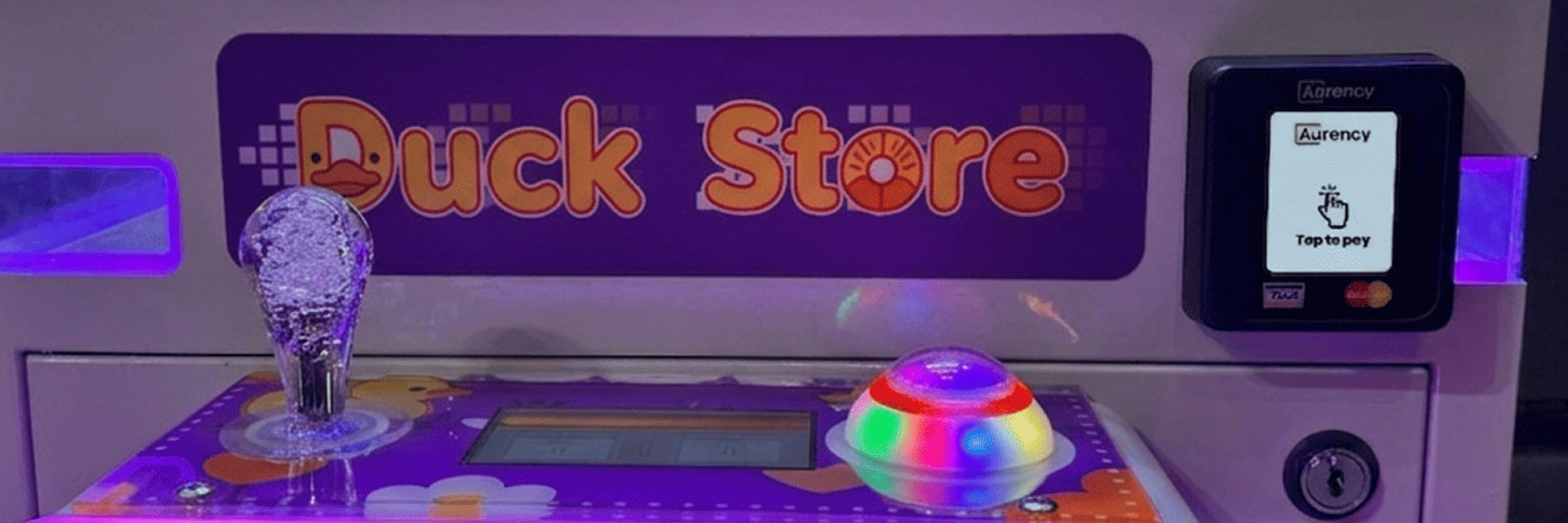
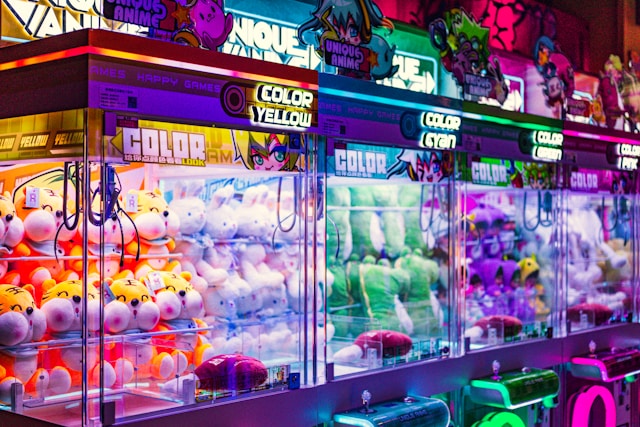
A player stops in front of your crane, reaches into a pocket, finds no change, and walks off. It happens in every mall and every cinema foyer, and it never shows up anywhere in your figures, because a sale that did not happen leaves no record.
Most operators of prize machines have looked at this and been told that card payment is not possible on their equipment. That advice normally comes from suppliers who work in snack and drink vending, where machines communicate over a data bus called MDB.
Cranes, capsule machines and most redemption cabinets use a much older interface called Pulse. The coin acceptor closes a contact, and the machine counts the closures as credit. Any terminal that can reproduce that closure will work on most cabinets, including ones built decades ago. So the answer is yes for the majority of prize equipment, and the conditions attached to that yes decide whether the installation works and whether it earns its cost back.
How prize machines differ
Three differences narrow the field of suitable products.
1. The interface. An MDB reader belongs on a snack and drink machine, and a claw or crane needs Pulse. Pulse support is not universal among payment suppliers, so ask about it specifically before you discuss anything else.
2. Ticket size. A play costs between fifty cents and two euros. At that size, the way a supplier structures its fees can take a large share of every transaction, which is covered further down.
3. Repeat play. A player who nearly won will often pay for another go straight away. They will only do that if paying is quick, so the speed of the terminal affects how much the machine takes.
How to tell whether your machine will work
A Pulse terminal reproduces what the coin acceptor already does. It closes a contact on the machine's credit line, the machine registers a credit, and the play starts. Every cabinet that accepts coins already has that line, so you can install card terminals on most crane and claw machines, including old ones. A small number of cabinets use non standard boards and need to be checked individually.
Three things decide the installation.
1. The signalling level on your credit line. Amusement cabinets vary here. The check takes a minute for anyone who has done it before, so a supplier who cannot answer from a model number is telling you something about their experience.
2. How many credits your machine gives for one pulse. Your cabinet has this set already, because the coin mech has been feeding it for years, and the terminal has to match it. A mismatch produces no error message and no alarm. The machine gives the player a different number of goes than they paid for. The transaction log looks completely normal, and you find the gap weeks later in the takings.
3. Whether your machine can tell the terminal to stop. A crane that has run out of prizes or thrown a fault will otherwise keep taking payments. Every one of those payments becomes a refund and a complaint. Most coin operated cabinets have a line available for this, and a terminal built for amusement equipment should be able to read it.
You can settle all three at once by sending your supplier the make and model, the year if you have it, and a photograph of the coin mech and its wiring.
What cash only is costing you
No published data exists on cashless adoption in prize machines specifically, so the figures below come from vending, which has a similar ticket size and the same impulse purchase behaviour.
Vending in North America and Europe still runs close to sixty percent cash. Mordor Intelligence puts cash at just under fifty eight percent of 2025 transactions. Worldwide the picture is further along, and Grand View Research puts cashless at 75.8 percent of retail vending machine revenue in 2025, with Asia Pacific the largest regional market at 56.4 percent of revenue.
Look hardest at what happens when the coin path is removed. Micro market kiosks have no coin mechanism at all, and they reached 96 percent cashless penetration in 2024. That is the ceiling. The distance between it and your own cash share is the size of the problem.
On the consumer side, around 55 percent of EU consumers now prefer cards or other digital methods, while the European Central Bank, quoted in the same report, finds that 60 percent still want the option to pay with cash. A crane that only takes coins loses every player in the first group who is not carrying change.
Apply that to one cabinet. Say a crane takes four hundred euros a month in coins, and half the people who walk past it have no change on them. That machine is running at roughly half the demand available to it, and a terminal costs a small fraction of what it is missing.
.jpg)
Does it pay off on a one euro play?
Hardware cost. Judge it against the takings of the individual cabinet. A reader that pays for itself on a busy mall crane may never pay for itself on a machine in a bowling alley corridor. Cashless skipped the amusement segment for years for exactly this reason, because terminals built for retail cost more than a weak crane earns in a season. Aurency cuts hardware cost by up to fifty percent against traditional payment solutions, which brings the marginal machine into range.
Fee structure. Ask how a supplier charges before you ask how much. Is there a fixed amount taken on every transaction, or is the pricing purely a percentage? Is there a monthly charge for software or telemetry on top? Two suppliers can quote you the same percentage and still cost you very different amounts, because a fixed fee per transaction hurts far more on a one euro play than on a three euro snack.
Coin handling. Handling coins costs money. You pay for the collection runs, for counting, for the float, and for the machine standing idle when coins jam. None of this appears as a separate line in your accounts, so it usually gets left out when you compare options.
What to look for in the reader
Six things, in the order they will disqualify a product.
1. Pulse support. This is the one hard requirement for prize equipment. Support for other protocols only matters if your route also carries vending machines, in which case one terminal across the whole fleet saves you a second installation playbook.
2. Authorisation time. The Aurency terminal completes a transaction in two to five seconds, depending on signal strength. Ask any supplier for their figure and ask what it depends on. On repeat play, the difference between three seconds and ten is money.
3. Per machine data covering cash as well as card. If your machines sit on someone else's floor under a revenue share, you settle with that landlord every month, and the argument is always about the number. Card data alone will not end it, because it covers only part of the take. The Aurency terminal can also listen to the machine's existing coin mech and note validator, count what they register, and record it as a cash sale. You get one report per machine covering both.
4. Behaviour when the machine fails to deliver. Payment goes through, nothing moves, and on a crane this happens every week. Aurency handles it with an automatic refund on a timeout you set. There is also a server side version, which issues the refund even when the terminal itself has dropped off the network. Offline acceptance for locations with bad signal is available as an opt in service, so ask about it if your machines live in basements or under a mall roof.
5. Your own cards and tokens on the same unit. If you run branded play cards, a second reader on the cabinet defeats the purpose. The Aurency terminal reads branded cards and tokens alongside bank cards, Apple Pay, Google Pay and QR. Balances are loaded, refunded or blocked remotely.
6. Certification, asked precisely. The device level standard is PCI PTS POI, which covers physical tamper resistance, key management and the device lifecycle. Acquirers normally refuse to onboard a terminal without a current listing. EMVCo Level 1 covers the contactless interface and Level 2 covers the payment kernel. Ask which of these a supplier holds and at which version. A general claim of being PCI compliant describes the processing environment and tells you nothing about the box on your cabinet.
What a card reader will not do
A payment terminal does not run ticket redemption, track your prize fund, or hold a payout ratio to target. If those are the problems you are trying to solve, a reader will not solve them, and no supplier should tell you otherwise.

Installing card reader on
1. Confirm compatibility, using the three checks above.
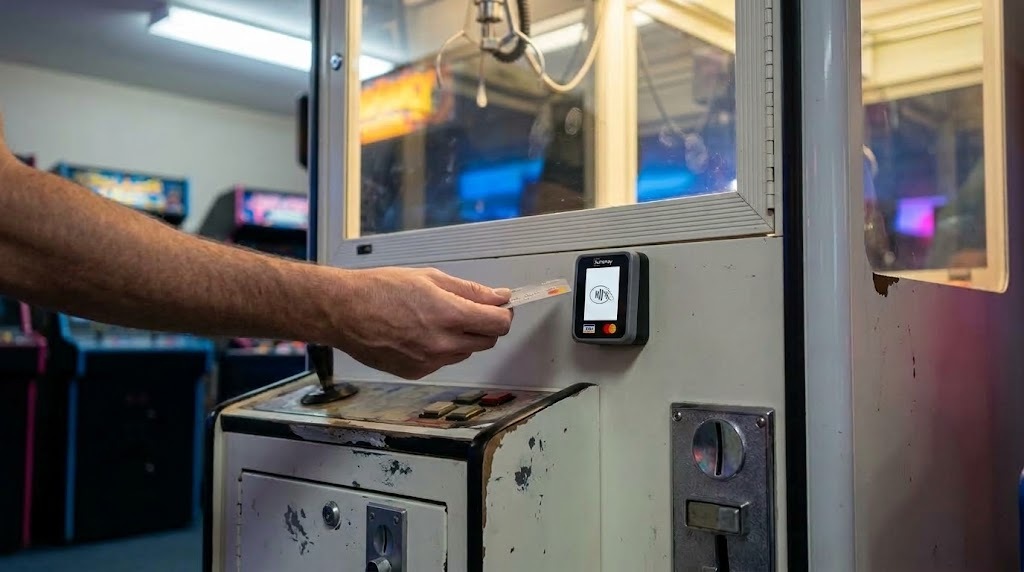
2. Mount the reader on the front of the cabinet, within reach of the player. Many machines have a pre cut aperture for a reader. Where there is none, an adapter plate avoids cutting the fascia.
3. Connect it to the credit line the coin mech uses, and take power from the machine.
4. Set the price or prices for a play in the terminal.
5. Set the pulse value, so that the number of pulses sent matches what your cabinet expects for one play.
6. Run one test payment and check what the machine actually credits. If the count is wrong, adjust the pulse timing and test again.
7. Wire the inhibit line if the cabinet supports it, so a faulted or empty machine stops taking payments.
8. Confirm the terminal is reporting to the dashboard before the cabinet goes back into service.
Connectivity is normally cellular, because the machine may move between locations and venue networks are rarely something an operator controls.
The equivalent process for vending machines, including MDB and EXE connection and the mounting options, is covered in our step by step guide to switching machines to cashless payments.
What changes after the first month
The obvious change is that people carrying no cash can play.
A faulted or empty cabinet now reports itself, so you find out before the location manager calls you. Each machine produces one report covering cash and card together, so when a landlord asks about the revenue share, the number is already there and the conversation takes a minute. Payments that go through without a play refund themselves, and the player is not standing at the machine asking you for two euros.
Coin collection does not disappear, since most operators keep the coin mech running. It becomes less urgent, because you can see what is sitting in each machine before you decide to drive out.
Common questions
Do I have to remove the coin mech? No, and on most sites you should keep it. The reader works alongside it, and can be set up to read it so that coin takings appear in the same report as card takings.
Will it work on a machine that is fifteen years old? Usually yes. Age is much less of an obstacle on amusement equipment than on vending, because the credit signal has not changed in decades. The machines that cause trouble are the ones with non standard boards.
Does it work on gashapon and capsule machines? Yes, because the same credit principle applies. These machines suffer most from cash only operation, since the ticket is small enough that nobody is carrying the right change.
Can I still take my own tokens or cards? Yes, on the same terminal, alongside bank cards and phone wallets.
What happens if a payment goes through and the machine does not deliver? The terminal refunds the card automatically once your timeout passes, and the server will issue that refund even if the terminal has lost connection.
About Aurency
Aurency builds all in one payment terminals for unattended retail. The Aurency A250 terminal combines contactless payment acceptance, payment processing, telemetry and VMS in a single device. It runs on 250,000 machines across more than 20 countries, with support seven days a week and a one year replacement warranty.
If you want to know whether a specific cabinet in your fleet will connect, send us the model and a photograph of the coin mech.

.jpg)